

Problem 3.2#
Integrated Energy Grids
Optimise the model described in Problem 3.1 without the CCGT generator. Calculate the revenues collected by the OCGT plant throughout the year and show that their sum is equal to its costs.
Note
If you have not yet set up Python on your computer, you can execute this tutorial in your browser via Google Colab. Click on the rocket in the top right corner and launch “Colab”. If that doesn’t work download the .ipynb file and import it in Google Colab.
Then install pandas and numpy by executing the following command in a Jupyter cell at the top of the notebook.
!pip install pandas pypsa
Note
See also https://model.energy.
In this exercise, we want to build a replica of model.energy. This tool calculates the cost of meeting a constant electricity demand from a combination of wind power, solar power and storage for different regions of the world. We deviate from model.energy by including electricity demand profiles rather than a constant electricity demand.
import matplotlib.pyplot as plt
import pandas as pd
import pypsa
Set parameter Username
Set parameter LicenseID to value 2767832
Academic license - for non-commercial use only - expires 2027-01-20
Prerequisites: handling technology data and costs#
We maintain a database (PyPSA/technology-data, v0.11.0) which collects assumptions and projections for energy system technologies (such as costs, efficiencies, lifetimes, etc.) for given years, which we can load into a pandas.DataFrame. This requires some pre-processing to load (e.g. converting units, setting defaults, re-arranging dimensions):
year = 2030
url = f"https://raw.githubusercontent.com/PyPSA/technology-data/v0.11.0/outputs/costs_{year}.csv"
costs = pd.read_csv(url, index_col=[0, 1])
costs.loc[costs.unit.str.contains("/kW"), "value"] *= 1e3
costs.unit = costs.unit.str.replace("/kW", "/MW")

defaults = {
    "FOM": 0,
    "VOM": 0,
    "efficiency": 1,
    "fuel": 0,
    "investment": 0,
    "lifetime": 25,
    "discount rate": 0.07,
}
costs = costs.value.unstack().fillna(defaults)

costs.at["OCGT", "fuel"] = costs.at["gas", "fuel"]
costs.at["CCGT", "fuel"] = costs.at["gas", "fuel"]
Let’s also write a small utility function that calculates the annuity to annualise investment costs. The formula is
where \(r\) is the discount rate and \(n\) is the lifetime.
def annuity(r, n):
    return r / (1.0 - 1.0 / (1.0 + r) ** n)
annuity(0.07, 20)
0.09439292574325567
Based on this, we can calculate the marginal generation costs (€/MWh):
costs["marginal_cost"] = costs["VOM"] + costs["fuel"] / costs["efficiency"]
and the annualised investment costs (capital_cost in PyPSA terms, €/MW/a):
annuity = costs.apply(lambda x: annuity(x["discount rate"], x["lifetime"]), axis=1)
costs["capital_cost"] = (annuity + costs["FOM"] / 100) * costs["investment"]
Now we can for example read the capital and marginal cost of onshore wind and solar, or the emissions factors of the carrier gas used in and OCGT
costs.at["onwind", "capital_cost"] #EUR/MW/a
np.float64(101644.12332388277)
costs.at["solar", "capital_cost"] #EUR/MW/a
np.float64(51346.82981964593)
Retrieving time series data#
In this example, wind data from https://zenodo.org/record/3253876#.XSiVOEdS8l0 and solar PV data from https://zenodo.org/record/2613651#.X0kbhDVS-uV is used. The data is downloaded in csv format and saved in the ‘data’ folder. The Pandas package is used as a convenient way of managing the datasets.
For convenience, the column including date information is converted into Datetime and set as index
data_solar = pd.read_csv('data/pv_optimal.csv',sep=';')
data_solar.index = pd.DatetimeIndex(data_solar['utc_time'])

data_wind = pd.read_csv('data/onshore_wind_1979-2017.csv',sep=';')
data_wind.index = pd.DatetimeIndex(data_wind['utc_time'])

data_el = pd.read_csv('data/electricity_demand.csv',sep=';')
data_el.index = pd.DatetimeIndex(data_el['utc_time'])
The data format can now be analyzed using the .head() function to show the first lines of the data set
data_solar.head()
| utc_time | AUT | BEL | BGR | BIH | CHE | CYP | CZE | DEU | DNK | ... | MLT | NLD | NOR | POL | PRT | ROU | SRB | SVK | SVN | SWE | |
|---|---|---|---|---|---|---|---|---|---|---|---|---|---|---|---|---|---|---|---|---|---|
| utc_time | |||||||||||||||||||||
| 1979-01-01 00:00:00+00:00 | 1979-01-01T00:00:00Z | 0.0 | 0.0 | 0.0 | 0.0 | 0.0 | 0.0 | 0.0 | 0.0 | 0.0 | ... | 0.0 | 0.0 | 0.0 | 0.0 | 0.0 | 0.0 | 0.0 | 0.0 | 0.0 | 0.0 |
| 1979-01-01 01:00:00+00:00 | 1979-01-01T01:00:00Z | 0.0 | 0.0 | 0.0 | 0.0 | 0.0 | 0.0 | 0.0 | 0.0 | 0.0 | ... | 0.0 | 0.0 | 0.0 | 0.0 | 0.0 | 0.0 | 0.0 | 0.0 | 0.0 | 0.0 |
| 1979-01-01 02:00:00+00:00 | 1979-01-01T02:00:00Z | 0.0 | 0.0 | 0.0 | 0.0 | 0.0 | 0.0 | 0.0 | 0.0 | 0.0 | ... | 0.0 | 0.0 | 0.0 | 0.0 | 0.0 | 0.0 | 0.0 | 0.0 | 0.0 | 0.0 |
| 1979-01-01 03:00:00+00:00 | 1979-01-01T03:00:00Z | 0.0 | 0.0 | 0.0 | 0.0 | 0.0 | 0.0 | 0.0 | 0.0 | 0.0 | ... | 0.0 | 0.0 | 0.0 | 0.0 | 0.0 | 0.0 | 0.0 | 0.0 | 0.0 | 0.0 |
| 1979-01-01 04:00:00+00:00 | 1979-01-01T04:00:00Z | 0.0 | 0.0 | 0.0 | 0.0 | 0.0 | 0.0 | 0.0 | 0.0 | 0.0 | ... | 0.0 | 0.0 | 0.0 | 0.0 | 0.0 | 0.0 | 0.0 | 0.0 | 0.0 | 0.0 |
5 rows × 33 columns
We will use timeseries for Portugal in this excercise
country = 'PRT'
Joint capacity and dispatch optimization#
For building the model, we start again by initialising an empty network, adding the snapshots, and the electricity bus.
n = pypsa.Network()
hours_in_2015 = pd.date_range('2015-01-01 00:00Z',
                              '2015-12-31 23:00Z',
                              freq='h')

n.set_snapshots(hours_in_2015.values)

n.add("Bus",
      "electricity")

n.snapshots
DatetimeIndex(['2015-01-01 00:00:00', '2015-01-01 01:00:00',
               '2015-01-01 02:00:00', '2015-01-01 03:00:00',
               '2015-01-01 04:00:00', '2015-01-01 05:00:00',
               '2015-01-01 06:00:00', '2015-01-01 07:00:00',
               '2015-01-01 08:00:00', '2015-01-01 09:00:00',
               ...
               '2015-12-31 14:00:00', '2015-12-31 15:00:00',
               '2015-12-31 16:00:00', '2015-12-31 17:00:00',
               '2015-12-31 18:00:00', '2015-12-31 19:00:00',
               '2015-12-31 20:00:00', '2015-12-31 21:00:00',
               '2015-12-31 22:00:00', '2015-12-31 23:00:00'],
              dtype='datetime64[ns]', name='snapshot', length=8760, freq=None)
We add all the technologies we are going to include as carriers.
carriers = [
    "onwind",
    "solar",
    "OCGT",
    "battery storage",
]

n.add(
    "Carrier",
    carriers,
    color=["dodgerblue", "gold", "indianred", "brown"],
)
Next, we add the demand time series to the model.
# add load to the bus
n.add("Load",
      "demand",
      bus="electricity",
      p_set=data_el[country].values)
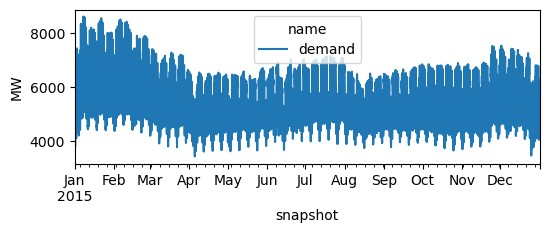
Let’s have a check whether the data was read-in correctly.
n.loads_t.p_set.plot(figsize=(6, 2), ylabel="MW")
<Axes: xlabel='snapshot', ylabel='MW'>
We add now the generators and set up their capacities to be extendable so that they can be optimized together with the dispatch time series. For the wind and solar generator, we need to indicate the capacity factor or maximum power per unit ‘p_max_pu’
n.add(
    "Generator",
    "OCGT",
    bus="electricity",
    carrier="OCGT",
    capital_cost=costs.at["OCGT", "capital_cost"],
    marginal_cost=costs.at["OCGT", "marginal_cost"],
    efficiency=costs.at["OCGT", "efficiency"],
    p_nom_extendable=True,
)

CF_wind = data_wind[country][[hour.strftime("%Y-%m-%dT%H:%M:%SZ") for hour in n.snapshots]]
n.add(
        "Generator",
        "onwind",
        bus="electricity",
        carrier="onwind",
        p_max_pu=CF_wind.values,
        capital_cost=costs.at["onwind", "capital_cost"],
        marginal_cost=costs.at["onwind", "marginal_cost"],
        efficiency=costs.at["onwind", "efficiency"],
        p_nom_extendable=True,
    )

CF_solar = data_solar[country][[hour.strftime("%Y-%m-%dT%H:%M:%SZ") for hour in n.snapshots]]
n.add(
        "Generator",
        "solar",
        bus="electricity",
        carrier="solar",
        p_max_pu= CF_solar.values,
        capital_cost=costs.at["solar", "capital_cost"],
        marginal_cost=costs.at["solar", "marginal_cost"],
        efficiency=costs.at["solar", "efficiency"],
        p_nom_extendable=True,
    )
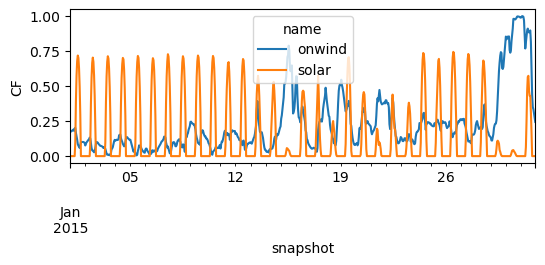
So let’s make sure the capacity factors are read-in correctly.
n.generators_t.p_max_pu.loc["2015-01"].plot(figsize=(6, 2), ylabel="CF")
<Axes: xlabel='snapshot', ylabel='CF'>
We add the battery storage, assuming a fixed energy-to-power ratio of 2 hours, i.e. if fully charged, the battery can discharge at full capacity for 2 hours.
For the capital cost, we have to factor in both the capacity and energy cost of the storage.
We include the charging and discharging efficiencies we enforce a cyclic state-of-charge condition, i.e. the state of charge at the beginning of the optimisation period must equal the final state of charge.
n.add(
    "StorageUnit",
    "battery storage",
    bus="electricity",
    carrier="battery storage",
    max_hours=2,
    capital_cost=costs.at["battery inverter", "capital_cost"]
    + 2 * costs.at["battery storage", "capital_cost"],
    efficiency_store=costs.at["battery inverter", "efficiency"],
    efficiency_dispatch=costs.at["battery inverter", "efficiency"],
    p_nom_extendable=True,
    cyclic_state_of_charge=True,
)
Model Run#
We can already solve the model using the open-solver “highs” or the commercial solver “gurobi” with the academic license
n.optimize(solver_name="highs")
WARNING:pypsa.consistency:The following buses have carriers which are not defined:
Index(['electricity'], dtype='object', name='name')
INFO:linopy.model: Solve problem using Highs solver
INFO:linopy.io:Writing objective.
Writing constraints.: 100%|██████████| 12/12 [00:00<00:00, 98.91it/s]
Writing continuous variables.: 100%|██████████| 6/6 [00:00<00:00, 643.22it/s]
INFO:linopy.io: Writing time: 0.16s
Running HiGHS 1.12.0 (git hash: n/a): Copyright (c) 2025 HiGHS under MIT licence terms
LP linopy-problem-30llxduv has 122644 rows; 52564 cols; 232162 nonzeros
Coefficient ranges:
  Matrix  [1e-03, 2e+00]
  Cost    [1e-02, 1e+05]
  Bound   [0e+00, 0e+00]
  RHS     [3e+03, 9e+03]
Presolving model
65718 rows, 48202 cols, 170874 nonzeros  0s
Dependent equations search running on 17520 equations with time limit of 1000.00s
Dependent equations search removed 0 rows and 0 nonzeros in 0.00s (limit = 1000.00s)
65718 rows, 48202 cols, 170874 nonzeros  0s
Presolve reductions: rows 65718(-56926); columns 48202(-4362); nonzeros 170874(-61288)
Solving the presolved LP
Using EKK dual simplex solver - serial
  Iteration        Objective     Infeasibilities num(sum)
          0     0.0000000000e+00 Pr: 8760(4.89297e+07) 0s
INFO:linopy.constants: Optimization successful:
Status: ok
Termination condition: optimal
Solution: 52564 primals, 122644 duals
Objective: 3.10e+09
Solver model: available
Solver message: Optimal

INFO:pypsa.optimization.optimize:The shadow-prices of the constraints Generator-ext-p-lower, Generator-ext-p-upper, StorageUnit-ext-p_dispatch-lower, StorageUnit-ext-p_dispatch-upper, StorageUnit-ext-p_store-lower, StorageUnit-ext-p_store-upper, StorageUnit-ext-state_of_charge-lower, StorageUnit-ext-state_of_charge-upper, StorageUnit-energy_balance were not assigned to the network.
      50549     3.1045882797e+09 Pr: 0(0); Du: 0(8.6763e-12) 2s

Performed postsolve
Solving the original LP from the solution after postsolve

Model name          : linopy-problem-30llxduv
Model status        : Optimal
Simplex   iterations: 50549
Objective value     :  3.1045882797e+09
P-D objective error :  5.5292799386e-15
HiGHS run time      :          2.30
('ok', 'optimal')
Now, we can look at the results and evaluate the total system cost (in billion Euros per year)
n.objective / 1e9
3.104588279721309
Calculate the revenues collected by the OCGT plant throughout the year and show that their sum is equal to its costs.
To calculate the revenues collected by every technology, we multiply the energy generated in every hour by the electricity price in that hour and sum for the entire year.
n.generators_t.p.multiply(n.buses_t.marginal_price.to_numpy()).sum().div(1e6) # EUR -> MEUR
name
OCGT      2110.448407
onwind     534.317737
solar      440.925417
dtype: float64
The market revenues correspond to the total cost for OCGT, which we can also read using the statistics module:
(n.statistics.capex() + n.statistics.opex()).div(1e6)
component    carrier
Generator    OCGT               2110.448407
             onwind              534.317737
             solar               440.925417
StorageUnit  battery storage            NaN
dtype: float64